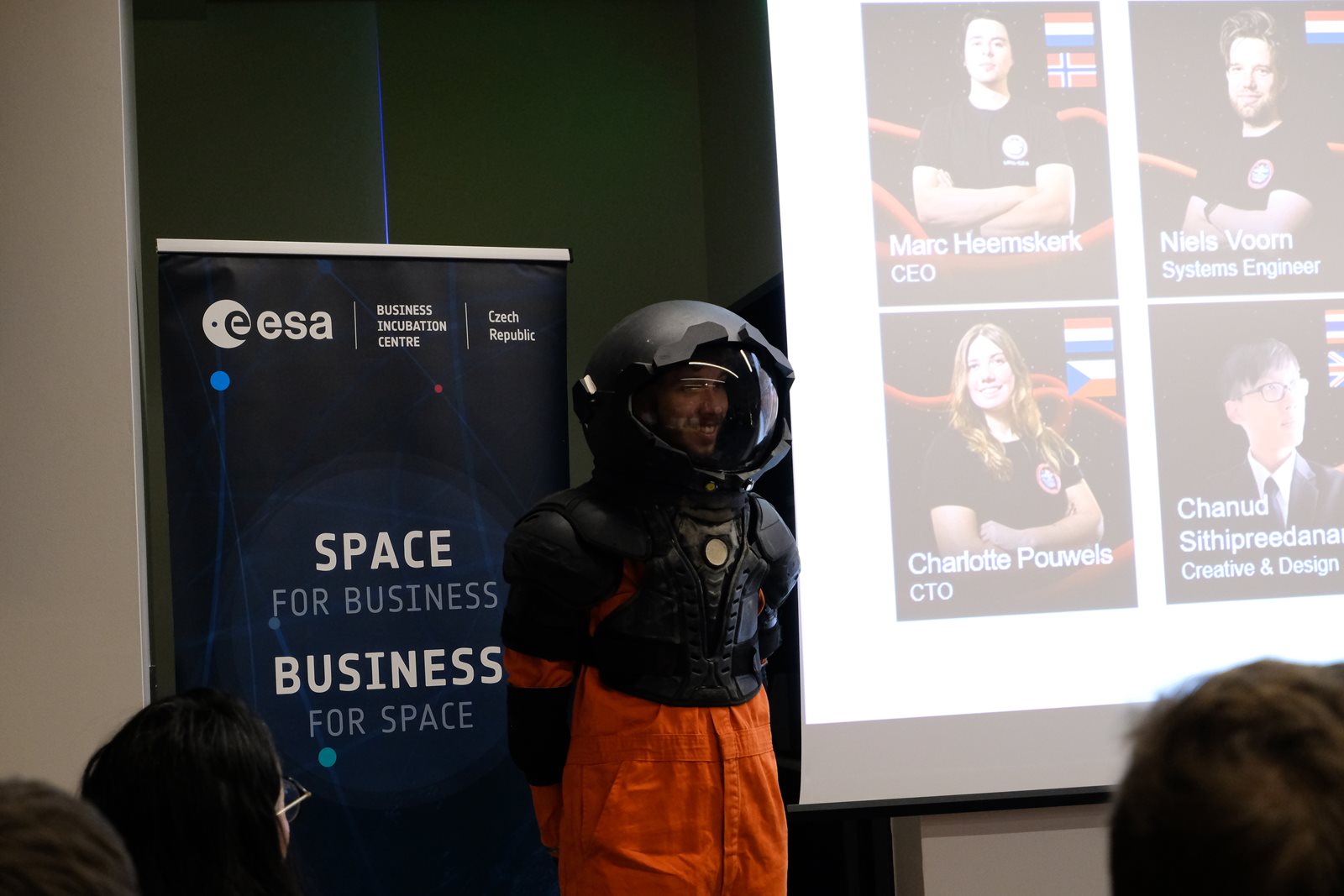
Prague has been a partner of the ESA BIC business incubation centre since 2016. The incubator, which is in the Czech Republic operated by CzechInvest, has facilitated launches of dozens of space companies with a turnover of hundreds of millions of crowns. Over the past decade, the incubator has become a key tool for the development of the Czech space industry, and thanks to it, Prague is profiled as one of the growing European hubs in this area.
The ESA BIC Czech Republic incubator was established in 2016 under the name ESA BIC Prague with the support of the CzechInvest Business and Investment Support Agency, the European Space Agency (ESA), the City of Prague and two ministries. ESA BIC Czech Republic is a part of ESA’s largest network of incubation centres, which has already financially supported over 2,000 space startups. Professional mentoring, technical consultations and access to experts help the incubated companies to put innovative ideas into practice and bring them to market in the shortest possible time. A total of 72 supported startups currently employ more than 500 people and their total turnover for the last year exceeded CZK 300 million.
Since 2018, ESA BIC has been organizing the annual Czech Space Week festival, each year with Prague as one of the main conference hubs. It includes the largest event focused on the space industry in the Czech Republic, Space2Business, the Copernicus User Forum academic conference, the Space Gala, the finals of the ESA BIC Liftoff Challenge business competition, and a debate with inspiring women Space4Women.
The Prague branch of the incubator is entering its strongest year so far: a record group of more than ten start-ups is in incubation, including in the areas of energy (Celestia Energy, HydroGENesis) and advanced materials (Malnus). Prague thus benefits from the development of its economy, and is also a potential user of the outputs of incubated companies: for example by using satellite data for environmental monitoring, a system for monitoring the safety of buildings and infrastructure, or a digital twin of the city, which will allow measures to be verified in a virtual environment before applying them in the real world. One of the successful projects of ESA BIC Czech Republic is, for example, Dronetag – a global leader in the development of technologies for the identification and monitoring of drones.
The interest in further development of the program in Prague has also been confirmed by the City Council, which approved the involvement of the capital city and the co-financing of the incubation centre until 2032 in the amount of approximately CZK 31 million. It has received support thanks to its successful operation and the results achieved so far.
“Space technologies already have a significant impact on the functioning of modern cities, and their importance will continue to grow. Prague wants to be part of this – it has been engaged for a long time in building an environment where innovative companies with international potential can be created and develop. In this respect, ESA BIC Czech Republic is an example of successful cooperation between the city, the state and international institutions, which brings specific results for the economy and quality of life. That is why the continuation of support for this program makes clear sense from the city’s point of view,” said Daniel Mazur, councillor of the capital city of Prague for Science, Research and Innovation and Smart City. ESA BIC Republic enters the next decade with the ambition to continue growing and strengthening its role in the Czech and European innovation ecosystem.